Overgrown branches scraping your roof in Windward. Dead limbs hanging over your kids' swing set in Cambridge. A canopy so thick your lawn has not seen sunlight in two years. These are the calls we get every week from Alpharetta homeowners, and they all point to the same fix — professional tree trimming by a certified arborist who knows what to cut, what to keep, and how to make the tree healthier in the process.
Proper tree trimming is a skilled trade that balances a tree's natural growth habits with the practical needs of your property. Hack it wrong and you create bigger problems. Do it right and the tree thrives for decades.
Walk through any neighborhood in Alpharetta — Crabapple, Downtown, the Encore subdivisions — and you will see the difference between trees that were trimmed by a certified arborist and those that were butchered by someone with a pole saw and no training. Properly trimmed trees have balanced, open canopies that allow air circulation and filtered light to reach the lawn below. Badly trimmed trees have stubs, torn bark, and clusters of weak sprout growth that become the next hazard during a Georgia thunderstorm.
When our crew trims a tree, we follow ANSI A300 standards — the nationally recognized specification for tree care operations. That means every cut is made at the proper location on the branch collar, promoting fast wound closure and minimizing decay entry points. We remove dead, dying, diseased, and crossing branches first. Then we address clearance issues — lifting the canopy off your roof, driveway, or fence line. Finally, we thin the interior canopy to reduce wind resistance and improve light penetration without stripping the tree bare.
The result is a tree that looks naturally shaped, not butchered. It is structurally stronger, better able to handle Georgia storms, and healthier overall because air and light reach the interior branches that produce next season's growth.
| Factor | Proper Trimming | Topping |
|---|---|---|
| Tree Health | ✅ Improves | ❌ Destroys |
| Wound Healing | ✅ Fast closure | ❌ Large open wounds |
| Storm Resistance | ✅ Stronger structure | ❌ Weak regrowth |
| Appearance | ✅ Natural shape | ❌ Ugly stubs |
| Regrowth Pattern | ✅ Controlled | ❌ Dense, weak sprouts |
| Property Value | ✅ Maintained | ❌ Reduced |
| Long-Term Cost | ✅ Lower | ❌ Repeated work needed |
| ISA Recommended | ✅ | ❌ Never |
From the initial walk-around to the final blowdown, every detail is covered so you do not have to lift a finger.
Before a single cut is made, we walk the property with you, identify every issue — deadwood, rubbing branches, clearance problems — and agree on the scope of work. No cutting starts until you approve the plan.
Every cut follows ANSI A300 standards. We cut at the branch collar — not flush against the trunk and not leaving stubs. This promotes fast wound closure and prevents decay from entering the tree's vascular system.
We selectively remove interior branches to reduce density by 15–25 percent. This improves airflow, allows light penetration, and reduces the wind load that causes branch failure during storms.
We establish proper clearance from your roof, siding, gutters, and any outdoor structures. Branches are cut back to appropriate lateral branches — never stubbed — maintaining a natural look while creating safe distance.
Every dead, dying, and broken branch in the canopy is identified and removed. This eliminates fall hazards and prevents dead limbs from becoming entry points for wood-boring insects and fungal infections.
All branches are chipped on-site. We rake underneath every tree we touch, blow off all hardscapes, and haul away every twig. Your yard will look better than it did before we arrived.
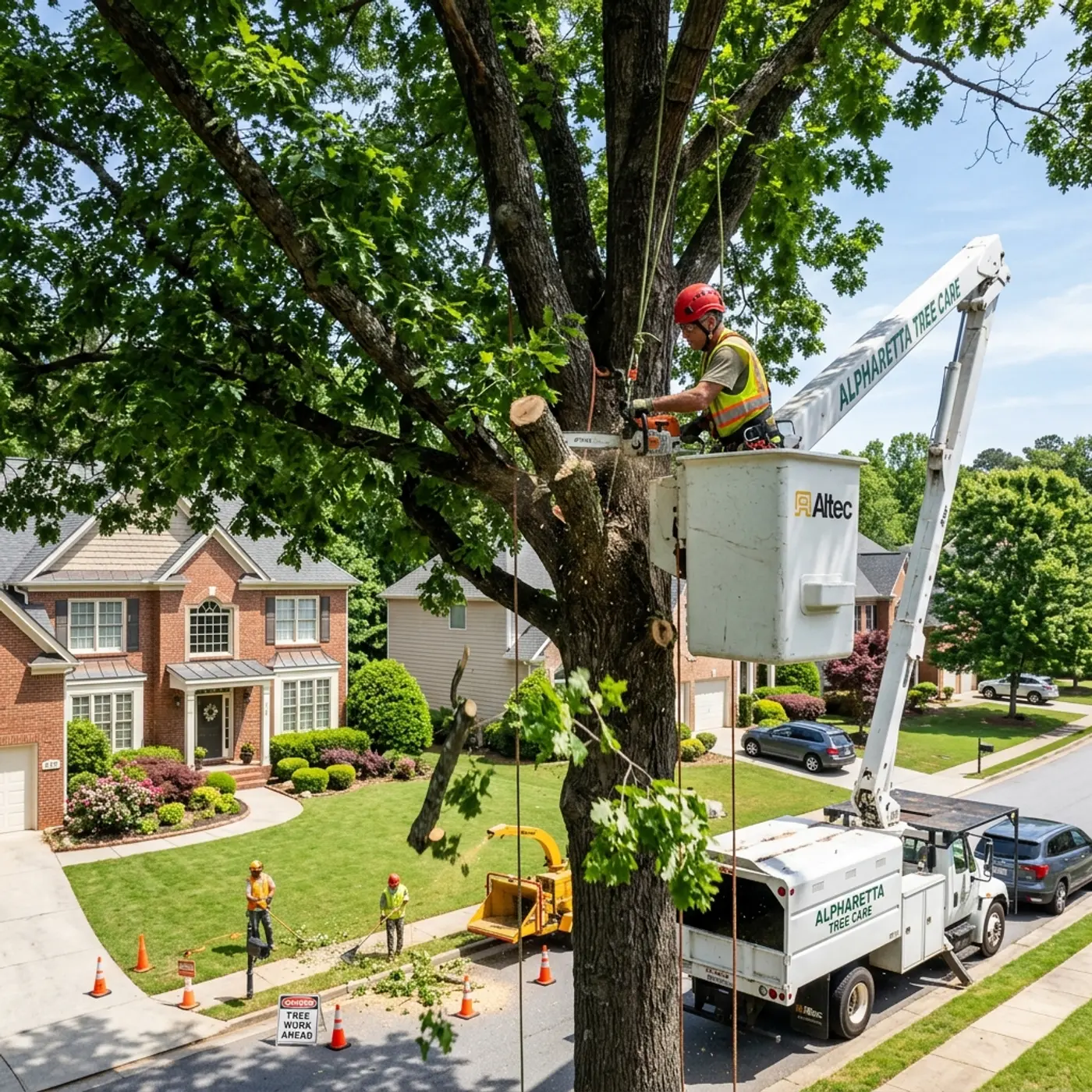
Topping is the most harmful thing you can do to a tree. It creates weak regrowth, massive decay wounds, and makes the tree more dangerous — not less. We use proper reduction cuts that maintain natural branch structure and the tree's long-term health.
Anyone can climb a tree with spikes and a chainsaw. Our ISA Certified Arborists understand tree biology — where to cut, how much to remove, and what happens physiologically after each pruning wound. That knowledge is the difference between helping and hurting your trees.
White oaks respond differently to trimming than water oaks. Loblolly pines need different timing than tulip poplars. We know the growth rates, wood densities, and failure patterns of every major species growing in Alpharetta, Roswell, and Johns Creek.
If a tree only needs three branches removed, that is what we quote. We do not upsell unnecessary work. And if a tree is beyond trimming and actually needs to come down, we tell you that honestly too — even though removal is a bigger job.
Uniformed, drug-tested, background-checked workers arrive on time in marked trucks. We protect your driveway with plywood under the chipper, use drop cloths on garden beds, and treat your property like our own.
Different situations call for different approaches. Here are the specific trimming techniques we perform and when each one applies.
Selective removal of interior branches to reduce canopy density. Improves airflow, light penetration, and storm resistance. Best for mature oaks and hardwoods with thick canopies common in North Fulton County.
Removing lower branches to increase clearance underneath the tree. Provides headroom for walking, mowing, and vehicle access. Also allows more sunlight to reach lawns and garden beds below the canopy.
Reducing the overall height or spread of a tree by cutting back to appropriate lateral branches. Used when a tree has outgrown its space or when clearance from structures is needed without removing the tree.
Selective branch removal to open up a specific view — a mountain vista, lake view, or backyard sightline — while keeping the tree healthy and naturally shaped. Common in elevated Alpharetta properties.
Systematic removal of all dead and dying branches throughout the canopy. Eliminates fall hazards, reduces pest entry points, and improves the tree's appearance. Recommended annually for large shade trees.
Correcting poor branch architecture — co-dominant stems, included bark unions, and crossing branches — to improve long-term structural integrity. Best performed on young to mid-age trees before problems become severe.
Removing broken, hanging, and split branches after a storm. We make clean cuts to promote healing, remove weight from compromised limbs, and assess whether the tree remains safe or requires removal.
Cutting branches away from roofs, driveways, walkways, play structures, and utility lines. We establish proper clearance distances per ISA guidelines — typically 10 feet from structures and 15 feet from utility lines.
Most residential tree trimming jobs in Alpharetta run between $250 and $1,200 per tree depending on size, species, and how much growth needs to come off. A single mature oak with extensive deadwood might run $800–$1,500. We provide free on-site estimates so you know the cost before any work begins.
Most hardwoods in North Georgia benefit from trimming every 3 to 5 years. Fast-growing species like sweetgums and tulip poplars may need attention every 2 to 3 years. Pines generally need trimming less often unless dead limbs pose a hazard. We assess each tree individually and recommend a schedule based on species, age, and location.
Late winter (January through March) is the ideal window for trimming most deciduous trees because they are dormant and you can see the branch structure clearly. However, deadwood removal and safety trimming can be done any time of year. We trim year-round across Alpharetta and North Fulton County.
Proper trimming by a certified arborist actually improves tree health. We follow ANSI A300 pruning standards and never remove more than 25 percent of the live canopy in a single session. Poor trimming practices like topping or lion-tailing cause lasting damage — which is why certification matters.
We trim trees that are near but not touching power lines. Trees in direct contact with power lines require coordination with Georgia Power or the local utility company. We can assess the situation, advise on the proper approach, and handle the work that falls within safe clearance distances.
Trimming generally refers to maintaining a tree's shape and removing overgrowth for clearance or aesthetics. Pruning is more targeted — removing specific branches for tree health, structural improvement, or disease management. In practice, most jobs involve both. Our arborists determine what each tree needs during the assessment.
We can manage canopy size through crown reduction pruning, which selectively reduces the height and spread of a tree using proper cuts back to lateral branches. We do not top trees — that practice causes weak regrowth, decay, and long-term health problems. If a tree has outgrown its space, we discuss honest options including removal.
Yes. Every trimming job includes full cleanup. We chip all branches on-site, rake the work area, blow off driveways and walkways, and haul away all debris. Your property will be cleaner than before we started.