Your trees are living assets — and like any valuable asset, they need maintenance to stay healthy, safe, and productive. A mature white oak in your front yard can add $10,000 or more to your property value. But that value disappears when disease takes hold, when soil compaction starves the roots, or when a preventable pest infestation kills the tree. Our tree care program catches problems early, treats them effectively, and keeps your trees strong year after year.
Most tree problems are fixable if caught early. By the time you notice a tree is dying, the underlying issue has usually been building for months or years. Regular inspections and proactive care prevent small problems from becoming expensive removals.
Alpharetta's heavy red clay soil is both a blessing and a curse for trees. It holds moisture well during droughts, but it compacts easily under foot traffic, parking, and construction. Compacted soil suffocates root systems — the tree looks fine above ground for a year or two, then starts declining. By the time the canopy shows stress, the roots have been struggling for seasons.
Construction damage is the leading killer of mature trees in Alpharetta's newer developments. Builders grade around existing trees, cut through root zones for utility trenches, and pile soil against trunks. The tree looks fine during the construction phase and for the first year after the family moves in. Then it starts losing branches, dropping leaves early, and developing canopy dieback. Within 3 to 5 years, the tree that sold the lot is dead — and the homeowner does not understand why.
Disease pressure in North Georgia is significant. Hypoxylon canker attacks drought-stressed oaks. Armillaria root rot spreads underground from infected stumps to healthy trees through root contact. Pine bark beetles exploit stressed loblolly pines, boring through the bark and introducing blue stain fungus that kills the tree within weeks. All of these are treatable or preventable — but only if caught by someone who knows what to look for.
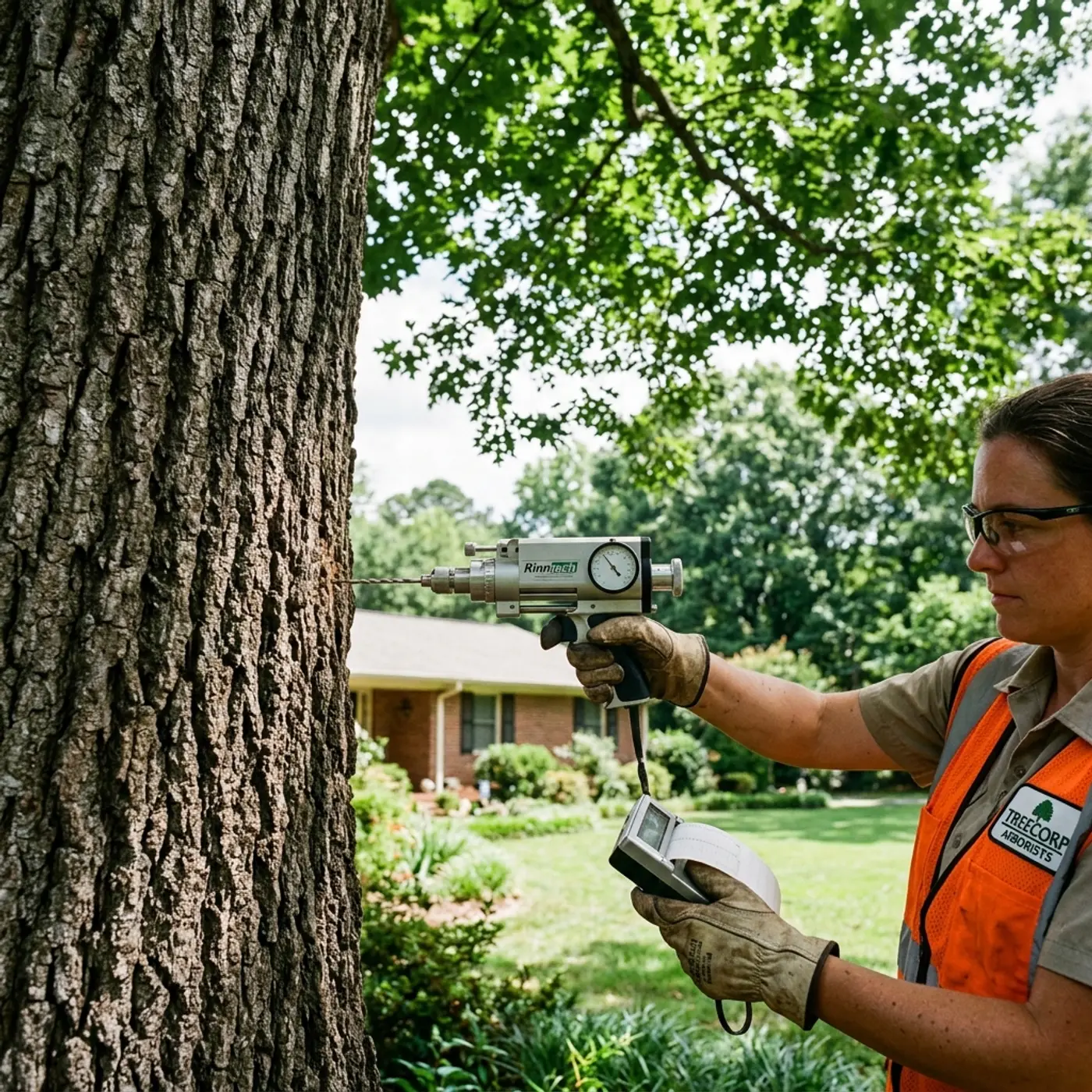
From diagnosis to treatment, we provide every tree care service your property needs to keep its trees healthy, safe, and valuable.
Thorough visual assessment of every tree on your property. We evaluate trunk integrity, root zone condition, canopy health, pest activity, and structural stability. You get a written report with prioritized recommendations.
Identification and treatment of tree diseases common in North Georgia — hypoxylon canker, oak wilt, leaf spot, anthracnose, and root rot fungi. We use targeted fungicide applications and cultural practices to contain and treat infections.
Pressurized injection of slow-release fertilizer directly into the root zone at 6 to 12 inch depth. Bypasses grass competition, breaks up compacted clay, and delivers nutrients where the tree actually absorbs them.
Monitoring and treatment for pine bark beetles, emerald ash borer, Japanese beetles, scale insects, and boring insects. We use integrated pest management — preventive treatments for high-value trees and targeted applications for active infestations.
Soil decompaction, mulching, and root zone aeration for trees in compacted urban soils. We reduce soil density around root systems using air spade technology and apply organic amendments to restore biological activity.
Formal risk evaluation for trees near structures, walkways, and play areas using ISA-standard Level 1, 2, and 3 assessment protocols. We identify failure risk and recommend mitigation — pruning, cabling, or removal — based on the findings.
Common signs: yellowing/browning leaves out of season, early leaf drop, cankers on bark, mushrooms at the base, crown dieback, and peeling bark. Schedule an inspection if you notice any of these symptoms.
We offer free initial consultations for residential properties. Advanced diagnostics — soil testing, lab analysis, resistograph testing — may have additional fees explained upfront.
Fall (October–November) and early spring (February–March) are ideal. Fall supports root growth through winter, spring fuels canopy growth. We use slow-release fertilizers via deep root injection.
It depends on the cause and stage. Early-stage disease, nutrient deficiencies, and minor pest issues often respond well to treatment. Trees with extensive trunk decay or 50%+ crown dieback are usually beyond saving.
Construction damage, compacted clay soils, pine beetles, oak wilt, Armillaria root rot, hypoxylon canker, and improper pruning. Many are preventable with regular care and early detection.
We apply preventive treatments to high-value uninfested pines. Once beetles are actively inside a tree, it must be removed to prevent spread. Early detection through regular inspections is the best defense.
Every 2–3 years for established properties, annually for properties with large mature trees near structures. After major storms or droughts, an immediate inspection is advisable.
Pressurized injection of slow-release fertilizer into the root zone at 6–12 inch depth. Bypasses grass competition, aerates compacted clay, and delivers nutrients directly to tree roots.