A mature white oak in your front yard is not just a tree — it is a living asset worth thousands of dollars in property value. Poor pruning destroys that value in a single afternoon. Proper pruning, performed by an ISA Certified Arborist who understands tree biology and growth response, strengthens the tree's structure, fights disease, and keeps it healthy for decades. That is the kind of pruning we do across Alpharetta and North Fulton County.
Pruning is the most misunderstood tree care practice. Done correctly, it is the single best thing you can do for a tree's long-term health. Done incorrectly, it causes decay, structural failure, and slow decline.
Every branch on a tree serves a purpose. It produces food through photosynthesis, provides structural support to the trunk, and helps distribute wind loads during storms. When you remove a branch, the tree must reallocate resources to heal the wound and compensate for the lost canopy. Remove the wrong branches — or too many — and the tree goes into stress.
Our arborists evaluate each tree's species, age, health condition, and structural architecture before making a single cut. We identify co-dominant stems that split under weight, included bark unions that trap moisture and decay, crossing branches that create wounds, and dead wood that harbors insects and fungal pathogens. Then we develop a pruning plan that addresses the tree's specific needs — not a one-size-fits-all approach.
In Alpharetta's clay-heavy soils, trees often develop shallow root systems that make them more dependent on their canopy for stability. Over-pruning removes too much weight from one side, shifting the tree's center of gravity and increasing the risk of failure during the thunderstorms and heavy rains that hit North Fulton County every summer. We balance every canopy we prune to maintain the tree's structural equilibrium.
| Aspect | Certified Arborist | Untrained Crew |
|---|---|---|
| Cut Location | ✅ Branch collar | ❌ Random stubs or flush cuts |
| Canopy Removal | ✅ ≤25% per session | ❌ 50%+ common |
| Tool Sanitation | ✅ Between cuts | ❌ Never |
| Species Knowledge | ✅ Growth response understood | ❌ Generic approach |
| Wound Response | ✅ Fast closure | ❌ Decay entry |
| Tree Topping | ✅ Never done | ❌ Common practice |
| Long-Term Health | ✅ Improved | ❌ Compromised |
| Standards Followed | ✅ ANSI A300 | ❌ None |
From young tree training to mature oak restoration, we handle every type of pruning work needed across Alpharetta and North Fulton County.
Establishing strong branch architecture in young and mid-age trees. We select a dominant leader, space scaffold branches properly, and eliminate co-dominant stems before they become structural hazards.
Removing diseased, dying, and insect-infested branches to contain the spread of pathogens. We sanitize tools between every cut and dispose of infected material off-site to prevent reinfection.
Rebuilding the canopy of previously topped or storm-damaged trees. We select the best-positioned sprouts to become new leaders and remove competing growth over multiple pruning sessions spread across 2 to 3 years.
Systematic removal of all dead branches throughout the canopy. Dead branches snap unpredictably and harbor wood-boring insects. Annual deadwooding is recommended for large shade trees near homes and walkways.
Reducing the length and weight of overextended branches that are at risk of failure. We cut back to strong lateral branches rather than stubbing — maintaining the tree's natural form while reducing breakage risk.
Detailed pruning of ornamental trees — crepe myrtles, dogwoods, Japanese maples, and magnolias — to maintain their natural beauty and form. We never "crepe murder" — that flat-top butchering that ruins crepe myrtles permanently.
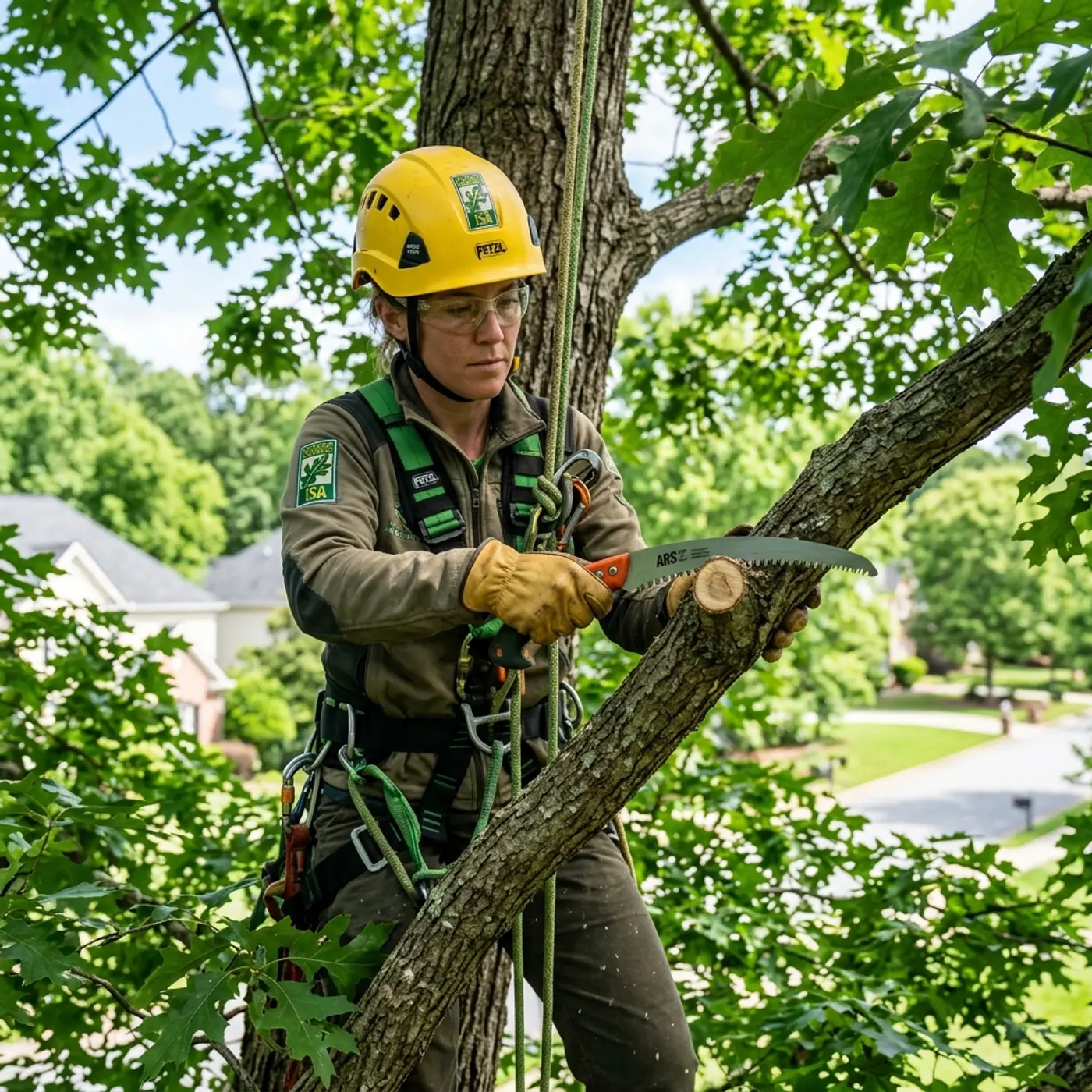
Pruning is not just about what to cut — it is about understanding how the tree will respond. Different species compartmentalize wounds at different rates. Oaks seal faster than maples. Pines rarely need pruning beyond deadwood. Our arborists know these differences because they have studied them and work with them daily.
We follow the nationally recognized ANSI A300 pruning standards on every project. That means proper cut locations, appropriate canopy removal percentages, and no harmful practices like topping, lion-tailing, or flush cutting. These standards exist to protect trees — and your investment.
When working with potentially diseased trees, we sanitize our tools with a hospital-grade disinfectant between every cut. Cross-contamination from unsanitized tools is one of the most common ways tree diseases spread in residential neighborhoods — and it is entirely preventable.
Trees that need heavy corrective work cannot be fixed in one session without causing stress. We develop multi-year pruning plans that gradually reshape the canopy over 2 to 3 seasons, giving the tree time to recover between sessions. This produces a stronger, healthier tree long-term.
We live and work in the same community. We see our pruning work drive past it every day. That accountability keeps our standards high. We prune trees in Windward, Crabapple, Milton, Roswell, and Johns Creek because this is home — not a service territory we drive hours to reach.
Pruning targets specific branches for health, structural improvement, or disease management. Trimming is broader — shaping a canopy or clearing overgrowth. Pruning requires deeper arboricultural knowledge because every cut affects the tree's growth pattern, wound response, and long-term structure.
Pruning costs typically range from $200 to $1,000 per tree depending on size, species, and extent of work required. Young tree structural pruning is usually less expensive than corrective work on mature trees. We provide free estimates with clear pricing.
Dormant season pruning (December through February) is ideal for most deciduous species. Flowering trees should be pruned right after blooming. Dead or hazardous branches can be removed any time of year.
ISA guidelines recommend removing no more than 25 percent of a tree's live canopy in a single session. More than that puts the tree under severe stress. If heavy pruning is needed, we spread the work across multiple sessions over 2–3 years.
Pruning infected branches can slow or stop the spread of many diseases if caught early. We sanitize tools between each cut to prevent cross-contamination. Some diseases require fungicide treatment or removal if the infection has reached the trunk.
Yes — young tree pruning is one of the most valuable investments a homeowner can make. Structural pruning during the first 5–10 years establishes a strong branch system and prevents costly corrective work later.
Yes. Topping, flush cuts, excessive removal, and pruning during active disease can cause irreversible damage. Flush cuts remove the branch collar — the tree's natural healing zone — creating wounds that decay organisms enter. This is why certification matters.
Yes. Many HOAs in Alpharetta require trees to meet specific clearance and canopy standards. We perform pruning to HOA compliance requirements and provide documentation of completed work upon request.